Five days after the brain tumour surgery Fred was recovering well. We were told they were going to remove the EVT drain – which meant Fred coming home was only days away. Having tubes in his neck and a bag of fluid hanging from his head was quite restricting and he wasn’t allowed to leave the ward. He was keen to get moving and had set himself the goal of visiting the in-house hospital Costa once he was free of his new ‘attachments’. He had the tubes in his neck removed earlier that day and we were waiting for a doctor to arrive to remove the drain, as nurses couldn’t carry out this procedure.
Fred was anxious but we managed some calm, almost normal, time as we watched, and he explained, Formula One to me on his laptop. I had a glimpse of the old Fred back, and it filled me with hope and joy.
It was about 6pm Friday 31 March when two doctors appeared at his bedside. Fred was nervous so I sat with him and held his hand while they did it. The younger of the two doctors was talked through the procedure by the older one. Once the drain was out the two doctors left his bedside, and then within what felt like just a few minutes Fred started to say he didn’t feel well. Shortly after he started to vomit, copious watery sick projected from his mouth, I held a cardboard sick bowl in front of him, and then quickly another, and another… I looked around for a nurse, “We need help, something isn’t right”.
I noticed his eyes: they looked different; they lost their direction; they weren’t him. He was speaking like he was drunk, slurring, not making sense and throwing his arms animatedly in the air. Then came the twitching as he lay like a stranger in the bed as they wheeled him for an emergency CT scan. “Stay with me Fred, you’re going to be ok” I demanded with the most intent of all directions I have ever given him. It seemed like he didn’t know who I was, his stare was beyond me, beyond anyone.
I was scared. Terrified.
I was losing my son, before my eyes.
I knew this was bad.
I found myself outside the scanning room, in sobs of desperation, again. I called Paul, who was promptly on his way.
As we returned to the ward, I was met with a doctor who introduced himself. He was the out-of-hours surgeon and had been called on to carry out an emergency operation – Fred’s third brain surgery in 7 days. He was friendly, and direct but confident, still holding his bag and wearing ‘civilian’ clothes.
I noticed it was dark, about 9 pm. And they took Fred to the theatre.
I sat in the waiting room, in shock and dismay by what had happened. Suddenly, and unbelievably the tumour and cancer weren’t the biggest worry; we were faced with immediate danger. It was now a question of survival, in this moment. Something threatened right here and now.
Will I get my son back?
With the events of the last week, I already had the heinous fear of losing him, but now I was faced with the monstrous merciless nightmare he may have already gone.
The clock ticked past midnight and it was now April 1st; Paul and I had been directed to the unoccupied ‘quiet room’. A small room on the ward, with a window, two sofas, a coffee table and a filing cabinet in the corner. On the wall is a plague commemorating its opening and a dedication to a man who was treated on the unit. There was a picture of a man on a motorbike and some more artwork. All in tribute to people who had been treated on the ward – some saved, and some lost. A nurse gave us blankets and pillows and made us tea – a simple demonstration of care that provided some comfort to my shaken soul.
We sat in the room waiting to hear if Fred was ok. I drank the tea, and between conversations of ‘what ifs’ and Paul doing a challenging and yet wonderful job of calming my mind, tried to get some rest.
At around 1 a.m., the surgeon came to see us in the quiet room. I jolted up, eyes wide open alerted to the words from his mouth, “He is doing okay”. I unclenched the coin in my fist.
He explained the situation, as I listened intently. The scan showed Fred had a clot on the brain, following the removal of the drain. Inserting and removing these drains is something they do all the time, he said, and this is very rare. It wasn’t possible to tell whether there was a direct relationship between drain removal and clot. In theatre, they had put another EVT in, on the opposite side of his head from the one that had just been removed. This would relieve the pressure from fluids trapped by this new obstruction until the clot itself had been absorbed back into the body. We were told the effects of this intervention wouldn’t be immediate. When we next saw him he wouldn’t be how he was before the bleed and there were no guarantees. In time he should get better, but to what extent was yet to be revealed, though the surgeon hoped for a full recovery.
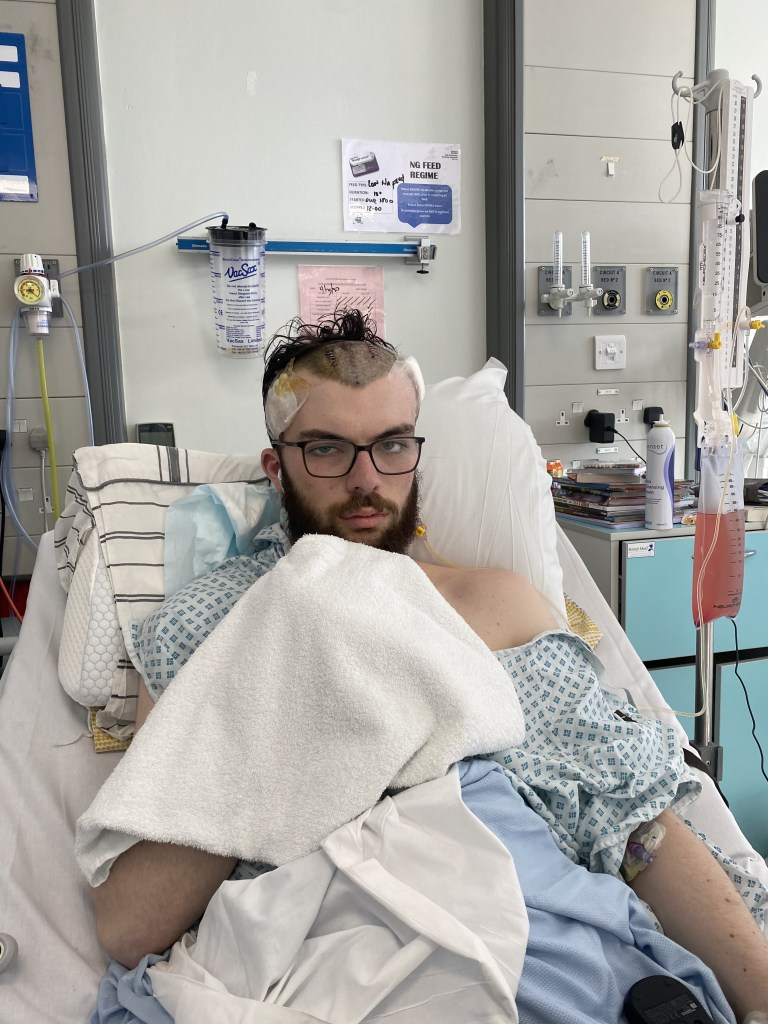
When he returned to the ward, with another wound, new adornments to his head, and the other half of his head shaved leaving a few tufts of long hair on the top. I thought he was not going to be too impressed with his new haircut. But he looked gorgeous to me. Even though I was worried about how he would be and if he would fully recover. He said, “Hi, Mum” and I was overjoyed he could recognise me. I was so pleased to see him, my beautiful strong boy.
I look around the ward and observe Fred is the youngest person there, by far. Most patients on the neurology high dependency unit appear to my untrained eye to be severe stroke patients, with tubes and breathing apparatus decorating each bedside. Loved ones are trying to talk to their person, reminding them who they are, or sitting by their side, looking around at this strange now familiar place in which they have landed. Some patients were able to communicate, others could not. I notice the desperate look of distress on a wife’s face as she sat by her husband’s bedside, holding his hand. I recognise it.
For days afterwards, Fred lay in the bed, floppy and not communicating, eyeballs uncontrolled and drifting in different directions. He was sleeping, not eating or drinking, and still vomiting and in pain. It was terrifying. It seemed like in the hospital bed was not my son before me, his body was there but the person I knew and desperately wanted back was not.
I recalled what the doctor said about it being a slow process and held fast to the belief my boy would return. Slowly, there were signs of improvement. A recognition. An action. It gave me hope. But it wasn’t linear. One minute, or hour, he appeared to be improving, the next he seemed to be going downhill. I was emotionally and physically exhausted but didn’t want to leave him alone in the hospital, so I stayed by his side and would only leave if someone else visited.
The following week, with the help of physios, his brother Logan, and myself, he was able to get out of bed for the first time and slowly stand up. This was huge, and as he towered above the rest of us, I was reminded he is too.
He wouldn’t be going to Costa or coming home anytime soon, but, thanks to the swift action of that surgeon and the team, my boy was slowly returning.


 Long live the fighters
Leave a reply to Bowness Jane Cancel reply