Monday came, as Mondays do – I was both relieved and terrified by the dawn of this, the most significant one. I arrived at the hospital early to ensure I saw Fred before they took him to theatre. It was outside visiting times, but I needed to see him. There was no way I could let my son go off for such major surgery by himself – I had to be with him. Fortunately, the ward staff, no doubt used to this, understood, and I was able to sit with him as we waited for the green light to go to theatre.
As I perched on the edge of the highbacked chair next to my boy’s hospital bed, his hand in mine, one of the surgeons on the operating team appeared in Fred’s corner of the high dependency ward. He introduced himself and drew the curtain around his bed. I quietly took a deep breath as I mentally, and emotionally, prepared myself for the day ahead. The surgeon had been sent to ensure Fred understood the operation he was about to have, and the risks that went with it, and record the evidence of this. As you may imagine with major brain surgery the list is alarming: stroke, brain swelling, bleeding on the brain, seizures, problems with speech, problems with mobility, infection, and loss of life.
“There are risks, but the risks of not having it done are greater” his surgeon told us, with a frankness I appreciated.
“You’ll be fine” I look at Fred.
He and I knew what we – he – had to do. Fred’s response was as strong as they come, “let’s do it then”.
“Look after my boy” I say, as the surgeon undraws the curtain and takes the signed piece of paper with him.
I stroke Fred’s hair – the half that remains – thick, dark and soft – the way I did when he was small. He was small once, albeit not for long, measuring off the centile chart from the day he was born. The prediction in the little red book came true; all 6ft 6 of him grew as predicted.
A moment later, a hospital porter and a nurse arrive to take Fred to theatre; it was time to go, time for me to leave him and let the medical team, hopefully, save his life.
I walk alongside his bed, preferring to stay with him for every moment I can. The NHS hospital bed is not designed for your taller than average person, so to accommodate Fred’s hefty height the bed had been extended. This proved a challenge for the lift; after some almost comedic manoeuvring, of which Fred and I see the funny side, the bed finally fits in, and I squeeze in alongside him. I escort him as far as I am permitted to go. I try not to make a fuss, not wanting to worry him – it’s business as unusual. I reassure him, remind him who he is, and tell him I love him, trying my hardest not to cry. “Love you too, mum”, he replied. I didn’t want to say goodbye, “I’ll see you after, I’ll be waiting for you”, I say. Fred, put in his earphones and played, ‘Baddest Of Them All’, and gave me the thumbs up as he passed through the secure double doors.
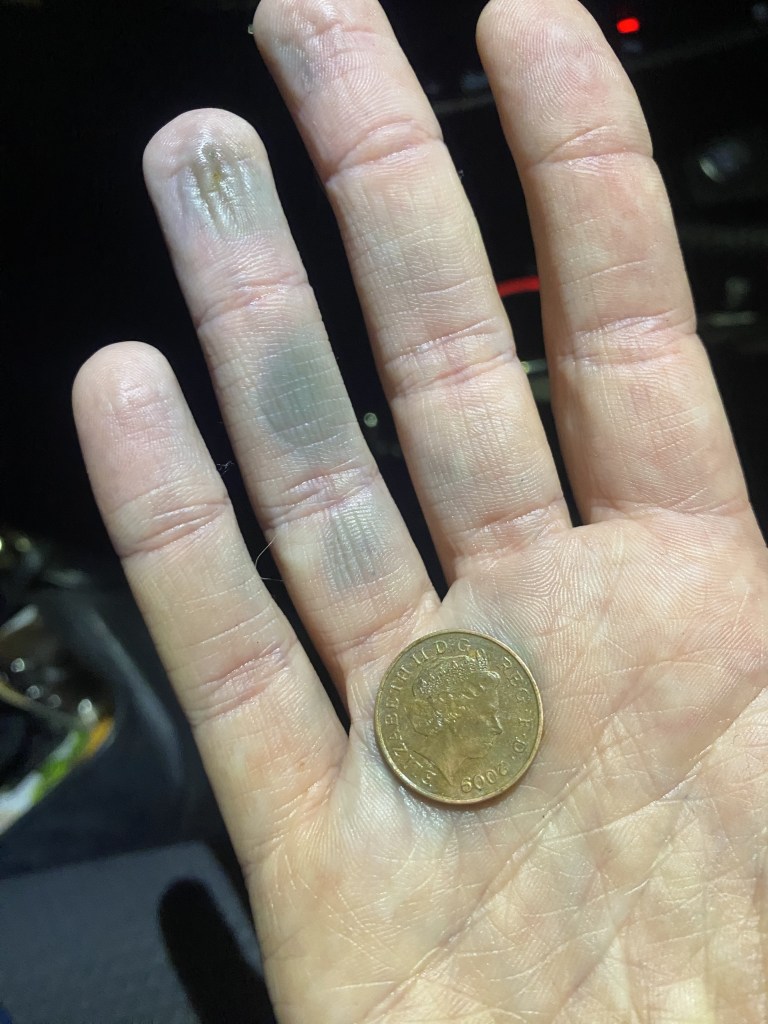
As soon as the doors closed and I stood alone in the grey and empty corridor, the tears came, suddenly bursting out of me like a freshly unplugged bath. I almost fell to the ground, but something held me up. I reach in my pocket and pick out the penny I’d found as I walked from the car park to the hospital earlier, ordered by the phrase, ‘see a penny, pick it up…’ I held it tight. I had done something similar when Michael was in surgery, having a life-threatening operation. I am both here and there, in that moment and in this one. Finding the solitude of the corridor, I speak to my late husband, the father of my children, looking up I will him to, somehow, be by his side, watching over him. ‘Look after our boy, make sure he comes through this’ I plead and pray with the penny held firmly in my palm.
I wipe my tears and make my way to the hospital Costa, where my partner, Paul, is waiting with a hug. I am unable to eat or drink, too anxious to consume anything, and my body is unwilling to leave the hospital. At that moment, I was surplus to requirements, but my requirement was to be mentally and physically by my son’s side, or as close as possible. I wanted to be in the same building as my boy; this made me feel closer to him – being in some way – not sure how – useful. The thought of leaving the building just felt so wrong. The maternal instinct is powerful, protective, and persistent. He may be 21, but I feel as responsible for him as I always have, especially now, feeling his safety, and happiness, in my hands. I wonder if I feel it more because I am his only parent; since he was 13, when his dad died, and I became both parents, I have developed an acute awareness of his every emotion and consequently painful cognizance of that which I could not fix.
The hours passed and having comprehensively outstayed my welcome in the coffee shop, Paul gently persuaded me to get some air, which I agreed, now knowing I wasn’t any use sat rigid on the pinky-purple chair. The sun was shining in a bright Spring sky, we walked, and walked, and didn’t stop walking. My feet doing the talking my mouth could not. Later I discovered my Garmin watch clocked over 10 miles through the streets of Hull that day. Having no idea where we were going, and wondering whether the wallabies and alpaca we passed were stress-induced hallucinations (they weren’t), we walked along the glistening Humber with the bridge in sight, and noted Liverpool Street, and Selby Street, and I saw it as a positive sign – the streets of Hull somehow talking to me to tell me my boy is ok.
Around 1pm I started to expect to hear something, some news from the hospital. But my phone had no answers. I checked my calls. Nothing. I checked my phone wasn’t on silent. I checked I had a signal. More walking. As more hours passed my anxiety was rising like someone had put that plug back in the bath. We returned to the hospital, just in case.
Eventually, I called the ward, “I haven’t heard anything, let me find out for you…”
“He’s still in theatre”.
We sat in the back of the car, to get a little rest. I didn’t sleep the previous night, my mind too occupied with the events of today, with the “what ifs” of all of this. I closed my eyes but couldn’t rest.
At 8.10pm, after eleven hours, I received a call – he was out of theatre and in recovery and “doing ok”.
Like coming up for air after swimming underwater, my lungs desperate for breath.
I slowly uncurled my stiff hand, having held so tight for so long the penny had left a blue-green stain on my palm. I had channelled every sinew of a mother’s love and protection of her son through the coin cocooned between my fingers and palm.
We learned that Fred went into theatre about midday and was waiting in the pre-theatre ward all morning with nothing but observing other patients and thinking about the operation ahead to occupy him. After he actually went into theatre, the team spent approximately 7 hours operating on him.
One of the surgeons told me on the phone, “The surgery went well. We were operating a long time, but we got everything we could see. We’ve done all we can here”.


 Long live the fighters
Leave a reply to Michelle Cancel reply